
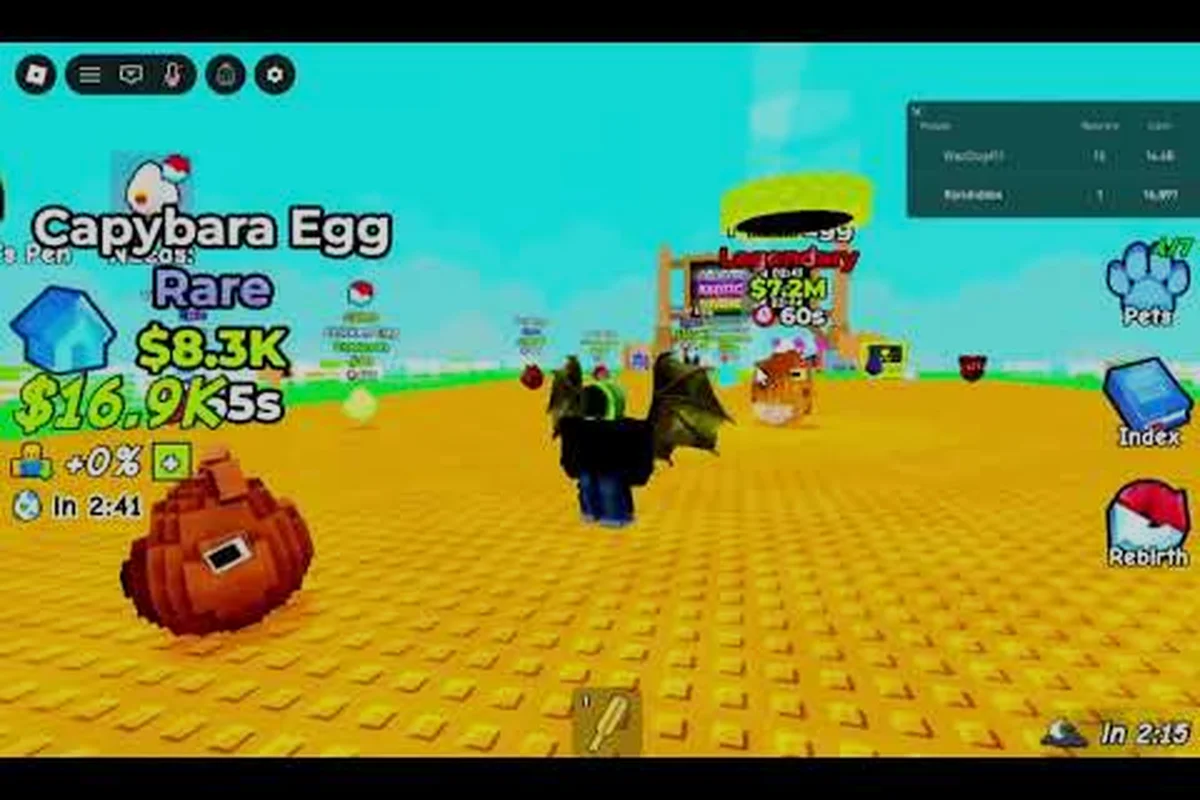
Fake an Egg rebirth matters because the reset trades your current pets, cash, and pens for a stronger income multiplier. This Fake an Egg rebirth guide shows how to reach 750 coins efficiently, choose productive pets, and decide when the first reset is worth taking.
Requirements and the Core Reset
Rebirth is the progression system in Fake an Egg where your current cash, pets, and pens are reset in exchange for a higher future income rate. The official Fake an Egg game page describes the game as a pet-collection and social-stealth title by Slime Time Studios, with rebirth functioning as its main long-term progression loop.
For your first cycle, the key target is 750 coins. Community guides and player reports consistently place the initial rebirth cost at roughly that amount, although exact prices and displayed requirements should be checked inside the current version. The official page confirms that multipliers can stack across rebirths, so the first reset is valuable even if your current collection is small.
The basic rebirth requirements are straightforward, but timing can determine whether the reset is worthwhile. A first rebirth at 750 coins sacrifices cash, pets, and pens for a permanently higher income multiplier; waiting for stronger pets or better pen production may improve the sacrifice, but it can also delay the increased coin rate. Use the first reset as a baseline, then compare later rebirth costs and stacked multipliers before triggering another reset.
-
Accumulate the required 750-coin balance.
-
Confirm that you are ready to surrender your current cash, pets, and pens.
-
Trigger the available rebirth option in the game interface.
-
Reinvest the larger starting income into better pets and faster pen production.
The reset itself is simple, but preparation determines whether you lose productive assets or avoid restarting from a weaker position. If you still need help collecting your first pets, the Fake an Egg hatch egg guide explains how eggs, hatching, and pet acquisition fit into the opening stage.
| Rebirth item | What happens at the first reset | Why it matters |
|---|---|---|
| Cash | Returns to a starting balance | You must rebuild the 750-coin reserve |
| Pets | Your current collection is lost | Keep only pets worth sacrificing |
| Pens | Existing pen setup is reset | Compare production before expanding |
| Income | Receives a higher multiplier | Future cash accumulates faster |
| Rebirth count | Increases by one | Multipliers can stack over later resets |
What the First Rebirth Actually Changes
The primary reward is not a one-time cash bonus. It is a persistent income multiplier, which makes every future coin easier to earn. If your first cycle produces a 750-coin balance through manual pen checks and pet income, the next cycle should reach the same threshold faster once the new multiplier is active.
That acceleration is why the Fake an Egg rebirth 750 goal should be treated as a milestone rather than an endpoint. Players should use the reset to establish a better economic loop, not simply race to the button the instant the balance appears. A short delay is worthwhile when additional cash would fund a stronger pet or prevent an immediate bottleneck.
Preparing Before You Press Rebirth
A good first rebirth should leave enough cash to restart efficiently, rather than reaching 750 coins with an empty treasury. For example, if your current pens generate 15 coins per second, a small reserve can cover the early rebuild while stronger pets begin contributing income. Prioritize replacing low-value pen capacity, then decide which hard-to-earn pets or permanent upgrades are worth purchasing before your next rebirth attempt.
Before triggering your first rebirth, treat the 750-coin requirement as only the minimum threshold, not the ideal stopping point. Build a reserve that lets your highest-income pets continue funding the rebuild; for example, at 15 coins per second, keeping 1,500–3,000 coins can provide a meaningful cushion for upgrades and pet purchases. If the next rebirth is close but your treasury is still thin, delaying for another income cycle may produce a faster restart than resetting immediately.
-
Keep only the pets that contribute meaningfully to your cash flow.
-
Avoid spending every coin on minor pen expansion immediately before resetting.
-
Learn where the rebirth control appears so the reset is not delayed by searching.
-
Confirm the displayed cost inside the game rather than relying solely on community estimates.
-
Plan the first purchase after resetting, since early income determines how quickly you rebuild.
Preparing Pets and Pen Income for 750 Coins
The fastest route to 750 coins depends on consistent pen income rather than repeatedly taking risky steals. A productive setup produces money while you handle other parts of the progression loop, reducing the amount of time spent watching every income tick. Community experience suggests that pets, pen upgrades, and the egg disguise are the main early progression pillars.
Start with the pet that gives the best practical return within your current cash range. A more expensive pet is not automatically better if it takes too long to earn back its purchase price. You want a short payback period, steady production, and a pet you are comfortable replacing at the next rebirth.
| Pet investment stage | Cash priority | Practical benefit | Rebirth decision |
|---|---|---|---|
| Starter pet | Low | Establishes the first income stream | Replace only when a faster option is affordable |
| Mid-tier pet | Moderate | Reduces the time needed for 750 coins | Keep if it replaces several weaker pets |
| High-output pet | High | Accelerates the current cycle and future resets | Rebirth if the purchase speed outweighs its retained value |
| Pen upgrade | Variable | Improves the number of coins produced per collection | Use only when the next income threshold is close |
Comparing Income Instead of Purchase Price
Calculate pets by income efficiency, not by their price tag. The value of a pet during a cycle depends on how many coins it produces, how quickly those coins arrive, and how much of your limited cash remains after buying it. A pet that takes 20 minutes to pay back 500 coins can still be excellent, but only if you would otherwise spend that period earning slowly.
A practical comparison looks like this: for your first rebirth at 750 coins, measure each pet’s total coins per 20-minute cycle, subtract its purchase cost and recurring upkeep, then compare the remaining income with what your current pen setup would earn. For example, a 500-coin pet that returns 125 coins every 20 minutes may be worth more than a cheaper pet producing only 50 coins per cycle, provided both have the same activation time. The key is to preserve enough cash to rebuild quickly, rather than maximizing purchase price or a single cycle’s payout.
| Evaluation point | Better choice | Weaker choice | Reason |
|---|---|---|---|
| Time to first income | Earlier production | Long activation period | Faster feedback reduces idle time |
| Coin output per cycle | Higher payout | Lower payout | More progress per pen check |
| Purchase cost | Affordable without starving savings | Requires every available coin | Preserves restart flexibility |
| Upkeep | Low or zero | Consumes coins repeatedly | Prevents income from leaking |
| Rebuild value | Easy to replace | Slow or expensive to replace | Improves the quality of a rebirth |
Do not overbuild during your first run. Spending too much can leave you with pets and pens that are excellent for another hour but poorly suited to a reset. Since the game prioritizes pen income, expansion is usually more valuable when another purchase brings the total close to a meaningful income threshold.
Keeping a Reserve for the Rebirth
A reserve is especially valuable when rebirth resets both pets and cash. If you spend down to zero, you may still reach 750 coins, but you lose the cushion needed to purchase a productive pet during the next cycle. A practical reserve is simply the amount you need for your preferred opener and one modest income upgrade.
Players often ask when to make that purchase. If the reserve is not yet safe but another pen check will nearly complete the total, wait one cycle when practical. If the game state clearly shows a strong pet is available and the remaining balance can still be rebuilt comfortably, buying it may be more efficient than hoarding an exact number.
The hatching side of the economy is covered in more detail in the egg-hatching guide, but the rebirth rule is simple: hatch for utility, not collection completion. A new pet has value when it improves your route to 750 coins; otherwise, it is spending that could have remained in reserve.
When to Rebirth in Fake an Egg
The best time for your first rebirth is when you have reached the required 750 coins, your current setup is no longer the fastest route to that amount, and you have a clear plan for the next cycle. Rebirthing earlier than required is impossible if the game blocks the option, while rebirthing immediately after reaching the threshold can still be inefficient.
Three useful moments to consider are after reaching the 750-coin rebirth cost, when your current income setup can no longer outpace the next cycle, and before upgrading items that would be lost on reset. For example, if you have 800 coins and can reliably earn another 150 quickly, waiting may preserve more resources than spending that surplus immediately; however, if 750 coins already unlocks a meaningful production multiplier, rebirthing sooner can shorten the next progression cycle.
| Decision point | Rebirth now | Wait and improve | Why |
|---|---|---|---|
| Exactly 750 coins | Avoid automatic confirmation | Check your next income step | A small head start may reduce reset time |
| 750 coins plus a strong pet | Rebirth if the pet is replaceable | Compare future production | The multiplier still applies after losing it |
| 750 coins with no reserve | Usually avoid an unplanned reset | Save for a basic opener | Starting from zero weakens the new cycle |
| Well above 750 coins | Consider rebirthing | Account for diminishing gains | Excess cash may soon be spent on upgrades |
The Practical Rebirth Threshold
Before committing to a rebirth, run a quick three-part test: check whether your coin balance has reached the 750-coin requirement, estimate how much longer your current pets and pens need to produce that total, and preview whether your existing income setup can be rebuilt quickly after the multiplier applies. For example, a player with 800 coins and slow-producing pets should usually reset, while a player with 600 coins and fast income may benefit from waiting briefly rather than starting a prolonged rebuild.
-
Requirement: The displayed balance meets or exceeds the required 750 coins.
-
Efficiency: Your current pets and pens are producing income slower than they will after the multiplier applies.
-
Readiness: You can rebuild a useful income setup without waiting for a long zero-money period.
When all three conditions are met, reset. If only the first condition is met, spend another short interval building a reserve. This approach answers the question of Fake an Egg when to rebirth with a practical rule rather than a vague recommendation to wait for the maximum possible number.
| Player situation | Recommended action | Expected result |
|---|---|---|
| First run, exactly 750 coins | Preserve a basic reserve, then reset | Stronger start without unnecessary delay |
| First run, 600 coins with fast income | Let the current setup finish the requirement | Avoid a long post-reset rebuild |
| First run, 800 coins with slow setup | Rebirth promptly | Replaces inefficient production with boosted income |
| First run, 750 coins but excellent pet | Compare remaining income first | Retains the pet only if it materially delays the reset |
| First run, unable to rebuild quickly | Delay slightly | Prevents a multiplier advantage from being wasted |
A common mistake is measuring the first cycle only by time spent earning 750 coins. The better measure includes the first few minutes after the reset. If the new multiplier requires a long restart, the net result may be worse than continuing the current setup for a short while.
Rebirth Immediately or Keep Earning?
Rebirth immediately when the current cycle has become inefficient, the requirement is met, and your next setup is clear. Continue earning when you are close to a meaningful upgrade, when your current income remains strong, or when resetting would leave you with no practical opener.
This is especially important for the Fake an Egg first rebirth, because later cycles can compound the benefit of a good starting position. The official game page reports that multipliers stack across cycles, so investing 30 extra seconds now can create a noticeably stronger foundation for every subsequent reset. A useful goal is to begin the next cycle with productive pets and enough cash to support them, not merely to trigger the animation as early as possible.
Fake an Egg Rebirth Cost, Income, and Long-Term Plan
The first rebirth cost is reported by community guides at approximately 750 coins, and that figure is the central target for new players. Since the official game page confirms the general reset-and-multiplier system, the community estimate for the starting threshold is best treated as current-version information to verify in the interface rather than an unchanging universal rule.
A simple first-cycle budget helps prevent overspending, especially because coins spent on a starter pet or pen setup can reduce the balance available for the 750-coin rebirth requirement. For example, reserving 300–500 coins for a preferred starter pet and 150–300 coins for pen capacity leaves room for the rebirth threshold plus a flexible buffer. The numbers below are planning examples, not fixed upgrade prices, because the available pet and pen costs can change with updates.
| Planned use | Coins reserved | Purpose |
|---|---|---|
| Rebirth requirement | 750 | Unlock the first multiplier |
| Preferred starter pet | 300–500 | Restore passive income after the reset |
| Pen setup | 150–300 | Rebuild collection capacity |
| Flexible reserve | 100–250 | Cover a small upgrade or temporary income gap |
Rebuilding Efficiently After the Reset
After rebirth, use a clear order of operations: first confirm that the new starter pet and basic income sources are already generating cash, then reinvest part of that income instead of spending it immediately. For example, if the reset unlocks a 750 rebirth requirement, compare the cost of reaching that cap with the additional earnings from the stronger opener; this helps determine whether continuing to collect is more valuable than resetting again. Each successful cycle should shorten the time needed to afford the next rebirth while preserving enough cash for the next upgrade.
-
Buy the best starter pet that fits the available cash.
-
Restore the basic pen arrangement that produced dependable income.
-
Add an upgrade only when it improves output enough to justify its cost.
-
Continue collecting until the next requirement is met.
-
Repeat the cycle with a stronger opener.
The Fake an Egg rebirth cap and reset strategy guide can help with later decisions, including whether an early reset is worthwhile and how to compare rebirth against continued upgrades. The key principle remains consistent: each cycle should improve the starting position.
Projecting the Value of Multiple Rebirths
Because multipliers stack, later resets should take less time than the first if you reinvest income well. Even so, the largest available pet is not always the best choice. A balanced setup earns more total coins across a full cycle, even if its individual payout is not the highest.
| Rebuilding priority | Long-term effect | Common mistake |
|---|---|---|
| Reliable starter pet | Faster return to 750 coins | Buying an expensive pet that pays back too slowly |
| Basic pen capacity | More collections during each cycle | Saving every coin instead of improving production |
| Moderate upgrades | Stronger income without a weak restart | Over-upgrading just before resetting |
| Reserve discipline | Smoother transition into the next cycle | Spending every coin on temporary extras |
The long-term plan should focus on cycle time, not only the size of a single payout. If a better pet reduces the time needed to rebuild the 750-coin requirement, it may produce less per collection but still improve the overall rebirth loop.
Practical Rebirth Checklist for Your First Cycle
A smooth first reset depends on preparation. Use this checklist during the run so you can distinguish useful upgrades from spending that disappears when pets, cash, and pens reset. The goal is to reach the requirement with enough information and money to restart cleanly.
Before Reaching 750 Coins
Focus on sustainable income and avoid unnecessary complexity. Purchase the pet that offers the best practical payback, keep the pen setup simple, and learn the restart sequence before it matters. The stealing and stealth guide can support faster accumulation, but manual steals should complement pen income rather than replace a stable economy.
-
Confirm that the current on-screen requirement is 750 coins.
-
Record the income rate of your best pet and basic pen setup.
-
Avoid spending the last portion of your balance on a nonessential pet.
-
Keep a small reserve for the first productive purchase after resetting.
-
Decide which current assets are safe to sacrifice.
Immediately Before Rebirthing
Check the balance, the displayed consequences, and your new-cycle plan one final time. If the amount is 750 and your setup is ready to be replaced, the reset is available. If you have a large surplus or a clearly better income setup, use a short additional cycle to make that advantage meaningful.
-
Verify the exact balance in the rebirth menu.
-
Make sure you understand which pets and pens will be lost.
-
Choose a replacement pet before spending the new balance.
-
Avoid clicking through a confirmation prompt without reading it.
-
Rebirth while the current cycle is no longer outperforming the boosted starting rate.
After the Reset
The first minute determines whether the new multiplier feels useful. Buy income first, rebuild only productive pens, and avoid buying a large collection that cannot pay back before the next reset. Repeating this simple sequence creates a cleaner second cycle and makes later Fake an Egg rebirth requirements easier to reach.
| First-cycle mistake | Result | Better response |
|---|---|---|
| Rebirth with zero reserve | Slow rebuild after reset | Preserve a basic starter budget |
| Keep a low-output pet | Longer time to 750 coins | Replace it with stronger income |
| Buy only expensive cosmetics | Less cash for production | Prioritize pets and pen output |
| Ignore the reset confirmation | Loss of valuable assets | Review every confirmation screen |
| Delay without a clear goal | Overspending before reset | Set a specific time or income target |
Frequently Asked Questions
What is the rebirth cost in Fake an Egg?
The first rebirth is widely reported by community guides to cost approximately 750 coins, which is why 750 is the standard first-cycle target. Because game balances can change, confirm the current amount in the rebirth menu before spending. The official game page supports the broader reset system, while the exact starting threshold remains best verified in-game.
How do I rebirth in Fake an Egg?
Reach the required coin balance, open the rebirth control in the game interface, and review the confirmation screen showing that your current cash, pets, and pens will be reset. Once confirmed, your rebirth count increases and the new income multiplier applies. Keep a basic reserve so you can rebuild a productive setup without returning to an empty account.
When should I perform my first rebirth?
Rebirth after reaching 750 coins when your current setup has become inefficient and you know which pet and pen arrangement you will rebuild. If you still have no starter budget, wait one short cycle. If your current income remains strong, continuing briefly may be worthwhile, but rebuilding after the multiplier becomes active is usually the better long-term approach.
Do pets and pens disappear after rebirth?
Yes. The reset clears your current pets, cash, and pens, then provides a higher income multiplier. That loss is why you should keep only assets whose production speed is unlikely to justify delaying the reset. Plan a replacement opener in advance and use the boosted rate to rebuild stronger than your first cycle.
Is an early rebirth in Fake an Egg worth it?
An early reset can be worthwhile because future multipliers stack and shorten later cycles. The trade-off is that you lose current pets and pens, so an immediate reset with no reserve may waste the advantage. Rebirth early when the requirement is met and your replacement setup is clear; otherwise, save enough to begin earning immediately.